Tuesday, February 15, 2011
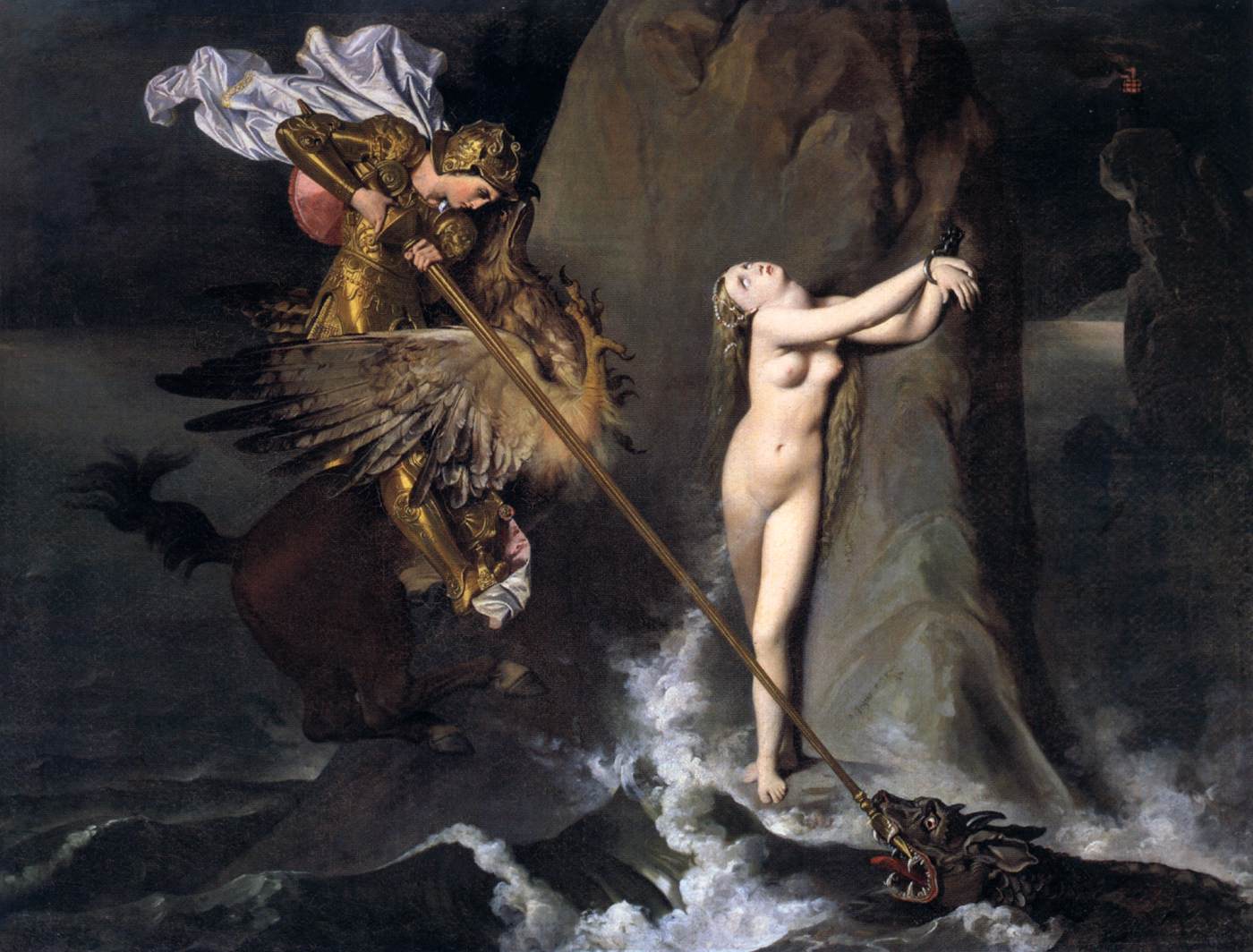
Roger Freeing Angelica -- Ingres
LARGER VERSION VIEWABLE HERE. I WOULD ADVISE YOU LOOK AT IT, BECAUSE IT IS BEAUTIFUL
And the not-whatsoever-related poem to accompany the painting: La Belle Dame Sans Merci, by Keats:
Oh what can ail thee, knight-at-arms,
Alone and palely loitering?
The sedge has withered from the lake,
And no birds sing.
Oh what can ail thee, knight-at-arms,
So haggard and so woe-begone?
The squirrel's granary is full,
And the harvest's done.
I see a lily on thy brow,
With anguish moist and fever-dew,
And on thy cheeks a fading rose
Fast withereth too.
I met a lady in the meads,
Full beautiful - a faery's child,
Her hair was long, her foot was light,
And her eyes were wild.
I made a garland for her head,
And bracelets too, and fragrant zone;
She looked at me as she did love,
And made sweet moan.
I set her on my pacing steed,
And nothing else saw all day long,
For sidelong would she bend, and sing
A faery's song.
She found me roots of relish sweet,
And honey wild, and manna-dew,
And sure in language strange she said -
'I love thee true'.
THE REST OF THE POEM CAN BE FOUND HERE
Friday, February 11, 2011
The Death of Leonardo Da Vinci -- Ingres
Feel free to compare to the Death of Marat, the Burial of Atala (both previously featured!), and the Death of General Wolfe by Benjamin West. Here's a poem by Dylan Thomas that befits these macabre subjects:
And death shall have no dominion.
Dead mean naked they shall be one
With the man in the wind and the west moon;
When their bones are picked clean and the clean bones gone,
They shall have stars at elbow and foot;
Though they go mad they shall be sane,
Though they sink through the sea they shall rise again;
Though lovers be lost love shall not;
And death shall have no dominion.
Under the windings of the sea
They lying long shall not die windily;
Twisting on racks when sinews give way,
Strapped to a wheel, yet they shall not break;
Faith in their hands shall snap in two,
And the unicorn evils run them through;
Split all ends up they shan't crack;
And death shall have no dominion.
No more may gulls cry at their ears
Or waves break loud on the seashores;
Where blew a flower may a flower no more
Lift its head to the blows of the rain;
Though they be mad and dead as nails,
Heads of the characters hammer through daisies;
Break in the sun till the sun breaks down,
And death shall have no dominion.
Friday, February 4, 2011
Romanticism: Caspar David Friedrich
Edmund Burke's notion of nature's sublime power to evoke a sense of mystery and loss of self is most consistently expressed in the paintings of the German Romantic, Caspar David Friedrich. For Friedrich, the sublime included the appeal of lunar folklore, myth, and German nationalism. He was particularly attracted to the theme of figures contemplating the moon, like the above painting, Moonrise over the Sea. Notice that the figures are silhouetted so that their identity becomes absorbed into the forms of nature. This sense of unity with nature, compounded by the haunting setting, conveys the figures' Romantic character.
The above painting, The Stages of Life, is a meditation on the artist's own mortality, depicting five ships at various distances from the shore. The foreground similarly shows five figures at different stages of life.
Monday, January 31, 2011
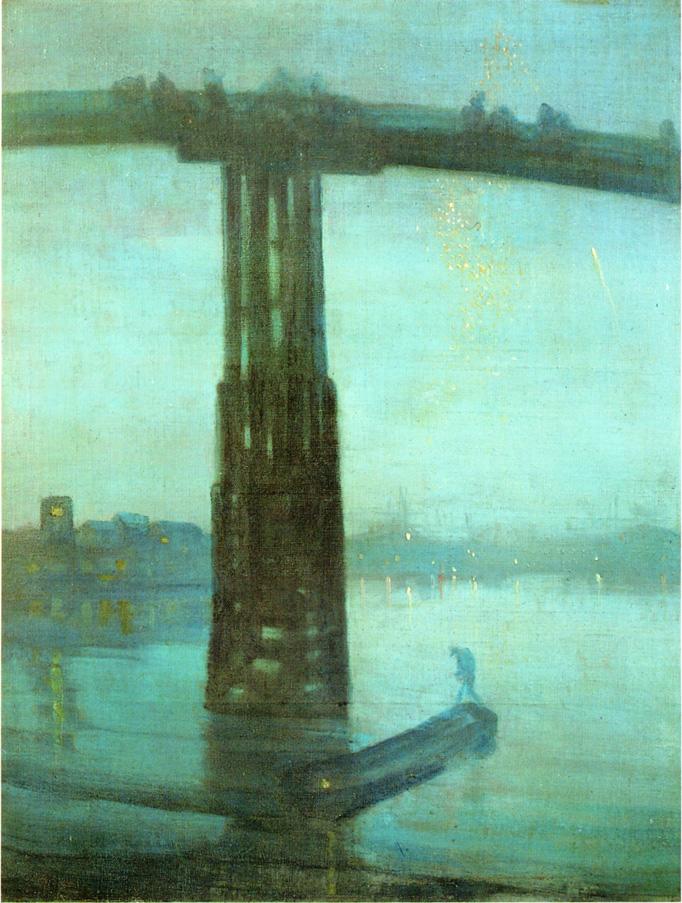
The Old Battersea Bridge -- Whistler
All this, of course, is with the exception of Whistler's most famous painting, which, if you want the inside tip, is the worst painting in the world.
Saturday, January 29, 2011
Wednesday, January 26, 2011
Gaspard de la Nuit -- Ravel
This is an excellent work by Maurice Ravel (pictured left), though he is not one of my most prized composers. It consists of three movements, each based on a poem from a collection (also titled "Gaspard de la Nuit") by Aloysius Bertrand (pictured right). Regrettably, I couldn't find any free on-line translations of the poems (let alone well-done translations). If any among you are interested to search, you won't hesitate to leave a comment indicating where it is.
The work as a whole comprises some of the most technically challenging music for piano solo in standard repertoire (meaning no random obscure modern composers like Sorabji and Finnissy, both of whom wrote practically impossible pieces; however these are very obscure and modern and thus not considered "standard repertoire"). In fact, Ravel wrote it to be intentionally more difficult than Balakirev's Islamey, which was considered probably the most difficult piece before that point. I will most likely make a post about Islamey in the future.
My favorite of the three movements is the first one, Ondine (pictured center). Here is the best recording I could find. I think this particular piece is incredibly subtle, and is not emotionally straightforward. To me, the entire piece is a contrast between a certain fantastical grace or beauty and then a dark, ghoulish underside. It seems to me that much of the higher themes and parts played by the right hand mark the graceful side of the piece, whereas the deeper, more sinister left-hand parts stand in stark contrast and provide those hints of something fiendishly mischievous at work.
Still more compelling is the notion of seduction and its relevance to the piece. Supposedly, the poem by Bertrand on which this movement was based (also titled "Ondine") described a water-fairy who attempted to seduce men and lead them to her underwater kingdom. This is obviously derived from mythological origins, as an Ondine was a nymph-like creature; and it was said that, if her husband was unfaithful, the Ondine would curse him so that he would suffocate the next time he went to sleep. In both of these notions of "Ondine," it is clear to me that the beauty of the Ondine is not so much a Platonic, "pure" kind of beauty, but rather a seductive one. To me, Ravel succeeds magnificently in expressing this idea of seduction musically.
Lastly, I enjoy how the texture of the piece mimics the warbling sound of trickling water, and in the more intense sections, sounds more like waves as one would hear at the ocean. This is a fantastic touch that also contributes to the accuracy with which the piece captures the subject of the poem.
The other two movements of the work are worthy of equally lengthy analysis because they are also (in my opinion) masterfully executed; however, I chose to write about the first movement simply because it appeals to me most personally. Perhaps at a later date I'll write posts about the other two movements. Only maybe not the second one, which is quite disturbing and I oftentimes find it hard to listen to in full.
Friday, January 21, 2011
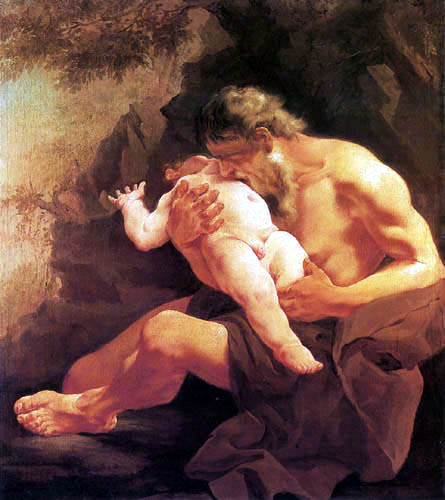
Saturn Devouring His Son -- Goya, Rubens, Tiepolo
Depicting the Ancient Greek myth of the Titan Cronus (Roman name: Saturn) who ate each of his children after learning from Gaia and Uranus that he was to be overthrown as king of the world by one of his children (as he overthrew his own father). Spooky, spooky stuff.
The first is Goya's rendition followed by that of Tiepolo and Rubens.
Subscribe to:
Posts (Atom)